Monday, April 26, 2010

Time Change [a little late]


One of the things I find confusing about living in the southern hemisphere is keeping track of the time difference between here and home. I had it figured out for a while - it was a three hour time difference between here and Austin. Then, Austin went forward and we were only two hours apart. A few weeks late Asuncion fell back and then we were only one hour apart. Over the span of a month I had a three, two, and one hour difference in times. Huh? Some of this is because Asuncion and the US didn't change their clocks at the same time. I'm used to time changes being just a few days apart, figuring it was some archaic reason that didn't have every country changing their time the same day. (Of course this only holds up when I don't think about that fact that there are some states and countries that never change their clocks). This year it seemed a bit different. I couldn't help but realize that the government of a country plays a definite roll in this.


Yes, it seems that the president decided to delay moving the clocks back in order to save daylight and cut down on electricity needs in the country, due to the energy crisis. The energy crisis? There is one of those here? I mean, I remember one day when all of the electricity across the entire city went out - but that only happened once that I can recall. I haven't really seen a crisis, at least not like the rolling blackouts that are common in other places. So I had to do a bit of research to find out what was going on.

It turns out that originally Paraguay was due to change time on March 14th. Due to problems with energy transmission it was pushed back to April 11th. And yes, this was official – as declared by presidential decree 3958. It doesn’t seem that the problem which lead to this change is the available energy, more that the mechanics which transport the energy are old and breaking down. In fact, from what I’ve been able to understand Paraguay doesn’t particularly worry about available energy. After all 90% of its power is supplied by Itaipu Dam, the hydroelectric dam on the Parana River between Paraguay, Brazil and Argentina.

Wednesday, April 7, 2010

A different kind of run


As I bent down to tie my shoe and then collected my timing chip it started to sink in that this was going to be a different kind of run. Everyone around me was wearing the black tank of the race, most of them paired with dark shorts - all designed to have them blend in more. Yes, blend in - because this is not an ordinary race, it's the Asuncion Night Run. As I crack my glow stick to make it shine and wrap it around my wrist, I see that I can get sprayed by Off - probably a good idea as we're running around the botanical garden. Oh - and there I can get a longer glow stick - fun! Perhaps it will work as an arm band as I'm not sure I can handle having it flap around my neck.

As the countdown gets close to the start I test my headlamp (part of our entrance package) and make sure it is well positioned on my forehead (although it turns out it doesn't stay up very well when you're sweating and running). 5 -4-3-2-1...the runners count down to the clock and then a flurry of fireworks explode overhead signaling the start of the race. And we're off. Its packed pretty tightly to begin with, but I'm surprised at how quickly the runners get stretched out. And by just how necessary the headlamp is for lighting a circle of ground ahead of me so I can jump over tree roots and avoid the holes. When I feel confident enough to look up briefly its an eerie sight to see a long line of bobbing lights in the dark. If I didn't know better I might suspect a gathering of extraterrestrials in the woods. Instead I turn my head down again and focus on a patch of ground just a few steps ahead catching a glimpse of a couple of other circles of light ahead of me and think about what an experience this has turned out to be. A much more solitary, glowing experience than I ever expected.

Friday, April 2, 2010

[Traveling Tale] Colonia del Sacramento, Uruguay


You could be forgiven being surprised when I tell you I've actually spent the last week in Uruguay. It just seems that the only time I actually have to write about a vacation is when I'm on another one. The week of Semana Santa, the holy week before Easter, sees me with a week vacation from school. And of course, a week off means another opportunity to travel.

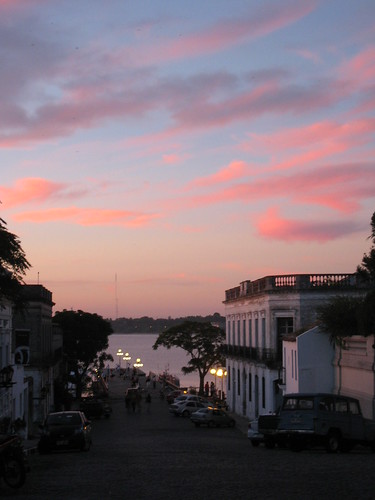
This time I decided to focus on two cities/towns - two days in Montevideo (which has been fairly uninspiring so you probably won't hear anything else about it) and the rest of the time in Colonia del Sacramento. A UNESCO world heritage site set along the banks of the Rio Plata, across from Buenos Aires, about all I knew before arriving was that it was an old colonial town. A part of me worried that it would be similar to Cartegena but except for sections of overflowing flowers that ended up not being true at all. Think cobblestone streets, an area of about six square blocks, every street running down to the white balustrade around the water. An old lighthouse, still functioning, where it only requires 118 stairs to get to the top. The oldest church in Uruguay (1680) surprisingly simple sitting next to a small square. Colorful sunsets over the water and harbor. Old stone buildings set next to taller tile and stucco houses. A wooden, golden spiral sculpture that called to my math teacher soul. Combine all that together with some pleasant green spaces and a population that doesn't hassle and you get a very pleasant place to unwind and relax for a few days.

[Traveling Tale]Cartegena, Colombia


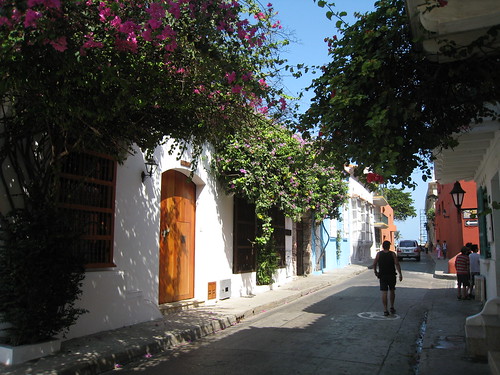
You drive in with a strong surf pounding the rocks on your right and the old walls of the city rising on your left. Within moments I'm sure this is going to be a lovely place to explore. We got dropped off at Lucy's, a woman who runs a B&B out of her home without any advertising, accepting guests only on recommendation from previous guests. Instant enchantment when we walk through the heavy wooden doors. Behind them lies a flower filled courtyard complete with fish pond, turtles and parakeets. The doors to the rooms opening in from there. As soon as we can drop our stuff and finish our lemonade we are itching to leave and explore. Where to start? At the fort outside the walls jutting above the city? Along the top of the old walls beside the ocean? Past the convention center with its giant statues of Pegasus? The streets of the old city are to much of a draw and its there we spend most of our time wandering. Who wouldn't be captivated by the brightly colored houses, the tumbling flowers which cascade over balconies and make the streets seem enclosed? Or the fancy doorknockers and smooth lines of the taller buildings. Arched gates lead out of the old city but we're content to roam past churches, small squares and the clock tower. Really, who wouldn't be enchanted by Cartegena?

Tuesday, March 30, 2010

[Traveling Tale] Ciudad Perdida


Some people were curious, why are you making Colombia your first destination from Paraguay? Lets face it, Colombia doesn´t have the best reputation (although I felt perfectly safe there). One of my friends who lived there for five years lured me to visit with her with the idea of hiking up to Ciudad Perdida (the lost city). A quick search for some pictures convinced me that I could get into this 6 day hike and that the view at the end would be entirely worth it.

Ciudad Perdida is located high up on land that is controlled by the Kogi, one of Colombia´s four main indegenous groups. They strongly believe in protecting the environment and being stewards for their region (living a simple, quiet mostly agricultural life). Access to the area is limited and you can only go up through oneof the five tour companies that operates trips.

We lucked out with our chosen Turcol tour - only six people hiking, four from our group and one other couple. Add in the guide and a cook and we had a total of eight. The trip up was to take three days, and while some days really did require a lot of up, I don´t think we ever hiked more than five hours in one day. Making the whole trip a pretty pleasant experience, especially for a multi-day hike. The three days down went a bit faster, even if it was harder on my joints.

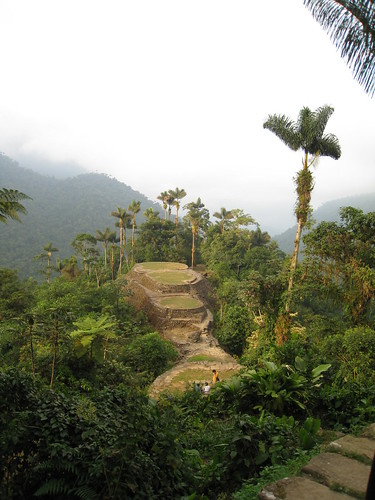
The challenge comes the third day when, after eight river crossings, you leave the river bed and begin climbing up the ancient stone steps laid into the mountain side. They claim its just 1200 of these up to the terraces. What they fail to mention is that those will only take you to the first lower terrace, and there is at least another 500 ahead of you to get to the main terraces. But it is worth it when you step up and see the main terrace ahead of you with a chain of about four more cut into the mountain side beyound. If you can ignore the presence of the military (there to protect the tourists) is seems magical. Calling you to explore and experience a small piece of this ancient communmity that laid stone pathways throughout the Sierra Nevadas. The site is a beautiful location set in the mountains where the mists roll in every evening to enclose you in a smaller world. But no matter what you might get distracted by you will always turn back to the terraces as if to assure yourself they are real and not something you imagined. Even as we started down, wandering past what they think was the quarry and additional smaller terraces, I know that I´ll leave here feeling as if I´ve had contact with a previous civilization. While I might enjoy being back down by the river and the peacefulness there, there is no doubt that the sight of the terraces on the mountaintop will be a lasting one in my memories.

Sunday, March 28, 2010

[Traveling Tale] 24 hours in BA


What do you do when you have a 24 hour layover in Buenos Aires? Well, when that means you have to go through immigration, pay the $130 entrance visa and collect your luggage you might as well go into the city. Knowing this was coming (due to flights changing after booking my ticket) I had booked a bed in a hostel and proceeded to lug my two as-heavy-as-allowed suitcases carrying my goodies from the US up two flights of stairs. Happily relinquishing them to the luggage room I ask the front desk for a mapy of the city, mark the location of the hostel and set off to find the closest "sites of interest" marked on the map. This led me to a plaza with the Metropotian Cathedral (a very boxy church) on one side adn to la Casa Rosada, the pink house, at the far end. Now if you´ve seen the movie Evita you´ll recognize this building as being the place where speeches and presentation were made. You can see that it really is a dramatic backdrop. A circular loop takes me past the national congress, some other old buildings and the obelisk. That is enough for round one. Travelling has made me tired and I need a nap!

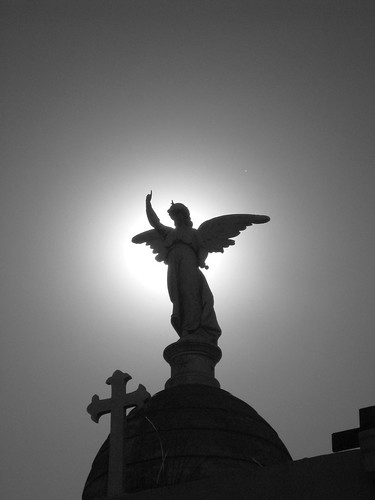
Awakening refreshed I decide to head a little father afield to one of the places everyone who visits mentions and make my way to Recoleta, the famous cemetery. Oh my. It is about one block large and it absolutely draws me in. I find myself happily taking pictures over the next hour and a half before closing time, drawn by the mix of regular and irregular lines on the above ground masoleums. Fascinated by decorative touches and all the statues of angles and women. A line around one corner tells me I´ve found the burial place of Eva Peron - covered n plaques but not located in a place of prime importance. I still feel as if I´ve encountered a piece of history. With a last lingering glance at this place that has let me escape the city amidst a mix of trnaquility and beauty, I head back to my bed knowing that if I had to have a long layover at least I´ve used it well. Perhaps next time I´ll manage to get more thatn 24 hours in BA.

Sunday, March 21, 2010

My Thermos


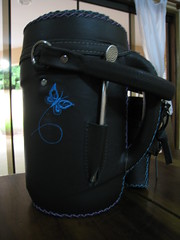
I figured I needed to post an update about my terere thermos. When I got back from Christmas break it was waiting for me with a friend and I have to say that it turned out to be remarkably close to what I had imagined while putting together my order. The dark brown leather with a purple and a teal butterfly embroided on it (my only complaint is that the two butterflies are so far apart you can’t see them both at the same time). The stitching is a mix of teal and purple. I can delight over the little details that always have to be a part of a thermos with all the extras – a sleeve for my bombillo (straw/strainer) and for the wampa (the cup). Perhaps my favorite though is the wampa itself. Smaller, the design show up well with the butterfly standing out, and yes – it is made out of cow horn. Now I feel like I own my own little part of Paraguayan tradition.