Showing posts with label paraguay. Show all posts

Friday, July 22, 2011

Ciao Paraguay

Bicentennial Color
It is hard to believe that I've already finished two years in Paraguay. To believe that I got on a plane at the end of June and may very well never return to what has been home. So as I say farewell to the country I just keep thinking of the top ten things that I'll miss from my South American sojurn.

10. Fireworks going off three to four nights a week and lighting up the sky. They may be noisy but they always bring a smile to my face.
9. Where else could you get wolf whistled at by a guy driving a horse cart hauling cardboard?
8. Unusual traditions that provide great photo opportunities, even if you can't understand exactly how they started.
7. Unexpected architecture in the middle of what seems to be a residential area.
6. Stealing tastes of ice cream from friends as we enjoy an ice cream break, after all there is practically a shop on every corner.
5. Natural fruit juice made out of any fruit you can imagine, and a few you've never heard of before.
4. How every year I've been there Paraguay has found a reason to decorate with red, white and blue to show their patriotic spirit. First it was the world cup, then the bicentennial.
3. The lapacho trees that turn the sky, and the ground, pink.
2. Hot crunchy on the outside, chewy on the inside, my favorite travel food...chipa!
1. Friends and coworkers who became my family away from home.

Saturday, June 11, 2011

Piki voley


Piki voley is an odd game. It reminds me of when I was little and my soccer coach took us to the tennis court to play a game over the net. In fact it is extremely similar. The setup - a short, low to the ground net and a square playing court on each side. The rules, or at least whet I've been able to figure out....

(1)service is a volley over the net
(2)whoever won the last point serves
(3)3 touches total on your side of the net, you must alternate who touches it
(4)you can have fewer than 3 touches but not more
(5)the ball can bounce once before you receive it (although I don't think it has to)
(6)no bounces allowed after the first touch on your side of the net
(7)game to....?? whatever you decide?

I do know this game can entertain my students for an entire lunch period, every day, and even make them late to class. It is enjoyed by the students that they put a small court in the main courtyard of the school. I have to admit it is kind of nice to have a name for something I've played on several occasions, even if it is unique to this country.

Wednesday, June 8, 2011

Mbaracayu

Last week we had about 20 girls come and visit our school from an all's girl school in the forest region of Paraguay. The school is run by a foundation called Mbaracayu. What they have done is created a secondary boarding school for girls who live in a remote region in the hopes that they will with education they will help their communities develop, and that it will aid them in stopping the cycle of becoming mothers themselves around the age of 14. It was interesting to talk to a few of the girls (somewhat of a challenge with my limited Spanish and their limited Spanish - they are much more comfortable with Guarani) and hear them share what sort of opportunities the choice they made to continue to school has provided. This video shares a bit of a glimpse of the school for those of you interested.

Sunday, May 22, 2011

sidewalks

changing pattern
I can't believe I'm really sitting here thinking I'm going to write about sidewalks. Have I become that desperate for a topic? No, really, I'm sure there are plenty of other things I could share, but I have to admit I spend a surprising amount of time thinking about sidewalks. This is probably because I get most places by walking, and due to the sometimes rough nature of the sidewalks here I spend the majority of that time looking down at the ground to try to save my ankles. So at least 40 minutes of my day is spent starting down at the sidewalks of this city. Put that way, perhaps it makes sense I'm going to share some of my observations from all of that time. What is interesting to me is that while almost every road has a sidewalk on each side, the sidewalks clearly belong to a house and not to the city or whoever deals with roads. Why do I say clearly? You only have to look down one block and see 4 or 5 different sidewalk styles to realize that they must belong to the house. Which explains why you can get a nice smooth sidewalk for 20 steps and then step onto a section which is broken, uneven and almost a pile of rubble. It explains why there are some sidewalks with fancy designs, others done in tile, and some with constant patterns that catch your eye. Since the sidewalk must go with the house, then it also makes sense that the owners of the house are responsible for their sidewalk getting/staying clean. Which is why most of them are free of leaves, flowers and other trash while there are occasional areas where it seems as if nothing has been cleared off in weeks. (It is very common for me to see women out sweeping the sidewalks as I walk to school in the morning.)I wonder what else I'll notice as I continue to walk?

Tuesday, May 17, 2011

Happy Birthday Paraguay

flag upright
On Sunday, May 15, Paraguay turned 200 years old. The entire weekend, or perhaps I need to say extended weekend as the government passed a movement to make Monday a national holiday for the bicentennial, was dedicated to celebrating this mile marker. The past month or so I noticed that Asuncion was starting to get dressed up for the bicentennial. Red, white and blue were getting hung on buildings all over the place (although perhaps not with quite the enthusiasm as last year for the world cup), flags were on sale on the street corners, stickers could be noticed on windows of buildings and cars alike. An entire program was set to go on over the weekend including numerous parades, music, ballet and such. I have to admit that I only managed to get myself downtown for a small portion of the going ons - namely the military parade. But what fun it was to watch the military procession and listen to those watchers cheer and comment on the groups that passed. You could feel the pride everyone had to be part of the country. The exclaimed over the groups that had their faces painted for camouflage or were wearing bush stealth outfits. Claps whenever a group of all women passed (one set of nurses with a red cross on their sleeve, one group from the navy, and finally a group of women carrying guns). Loud cheers when the reservists, any person who had previously served in the military (and by definition here could still be called up if the need arose), entered the street. Especially for the 102 year old man holding on while standing in the back of truck. Curiosity when a group from a different country marched by (Bolivia, Argentina, Brazil and others). Excitement to see the tanks and heavy equipment. Distraction when the planes and helicopters flew overhead. Bouncing to the music when a band passed by. And of course, ohhing and awing over the mounted groups and the decorated horses. Despite the rain delay everyone was thoroughly enjoying themselves. I have to admit that my favorite memory of the weekend happened because of the 30 minute rain delay. Some of the big wigs from the military where standing in trucks when the rain started to pour down. They didn't stay there long, but instead climbed down to escape someplace a little drier. Which is how I found myself sharing my umbrella with a 3 star colonel. (Ummm...this is a bit unreal!)What to do, but hold the umbrella a little bit higher? I had a nice 35 minute chat with Jorge, and then everyone was lead back out to the street for the start of the parade (which of course took at least another 10-15 minutes).

Congratulations Paraguay on 200 years! Happy Bicentennial!

Saturday, May 7, 2011

Monumento Natural Cerro Koi

May 1, 2011For a few months now I've been bugging a friend to take me out to see something she mentioned in passing. Last weekend our schedules finally worked out and we managed to spend a day in Aregua, a lake side town which is know for its pottery and the Strawberry Festival. However neither of those two things were what interested me this trip. No, I was sitting up in anticipation in the back of her off road vehicle as we bumped up the uneven road, following a policeman on his motorcycle (just an extra measure of safety), to the hillside of Cerro Koi (which means two hills in Guarani). Despite everything she had told me I didn't really know what to expect. I just knew that I was going to see an extremely rare geological formation which only exists in three parts of the world (Paraguay, Canada and South Africa). How to put it? After over over an hour on the internet I still can't give you a proper name for the formation, nor could I tell you where in those other two countries the formation is found. There is a definite lack of information out there. So, instead, you'll be stuck with what I learned there, but mind you, I don't have any way of substantiating what was told to me. The natural monument is composed of two hills (hence the name) which are extinct volcanoes. As the lava was cooling just the right conditions were met to produce a sandstone formation of what looks like tiered hexagonally shaped rods all piled on top of each other. The hill that we had access to by foot, was significantly mined. In fact the guard told us that originally pieces of the sandstone were broken off and used to cobblestone the streets in Asunción and Luque. I am a bit confused because I had assumed that the rods would be going up and down, however they were laying on their side. Did the volcano fall over? Or is this the natural lay? We couldn't get close enough to see the rods in the second hill so I don't know if they went a different way. However I was able to get close enough to the exposed hillside to appreciate the precise formations that nature is able to create! After marveling at the seemingly impossible formation we then followed the guard up and around to the top of part of the hill. A great chance to get a feel for just how large Lake Ypacarai is and to look over the countryside around Aregua.

Perhaps one of the most interesting things about going to see this geo-morphological phenomenon is that so few people seem to know about despite it being declared a protected area in 1993. In fact when I went to school on Monday people were curious as to where I had gone to see such a different sight. I find it sad that people who are interested in exploring a country don't know about, and have trouble finding out about, things that are only an hour away. For those of you interested, the entrance to the Monumento Natural Cerro Koi is marked by an sign to your right about 1 km out of Aregua on the branch road to Capiatá. It is well worth a trip to check out!

Thursday, April 14, 2011

Bus rides

small chipaMy mom is here visiting for a while, which means I've been revisiting some of the places that are worth exploring in Paraguay. It also means that we've been taking a lot of bus rides, which reminds me of what I like about riding a bus. While I might not get a good night's sleep while spending the hours between 1 and 6 in the morning on a bus, the daytime rides to provide a great perspective to observe bits of daily Paraguayan life. I'm amused by what you might see while driving by - overfilled motorcycles, trucks filled with logs beyond expectation, the bright colors of sponsored little stores on the side of the road, stretches of green scenery which show the true beauty of the countryside, plenty of pigs and cows...I could keep going. However, my favorite part of riding in a long distance bus is the chipa. Chipa is a Paraguayan bread made out of cornmeal. Oven baked it has a crisp outside and an almost gooey chewy inside. When it is hot it is one of my favorite snacks. After several more trips on the bus I still hold that the best chipa I've had in country is what I've bought from the man who comes on to the bus between Encarnacion and Asuncion. He climbs up to the upper level of the bus with his full basket of warm chipa, chirping "chipa, chipa, chipa"and you can bet that I will be digging in my bag to find some change. He slowly makes his way up the aisle, selling something to almost every row of seats, and once he finishes the bus stops again to let him off 15-10 km down the road, where I suppose he will wait to board a bus headed in the opposite direction. In the meantime I'll keep staring out the window happily chewing on my chipa.

Thursday, April 7, 2011

Tourism video

As part of everything else that is going on for the bicentinial (I got invited to march in a parade with teachers, students and their families today) the Paraguayan tourism department has published a new video promoting tourism to Paraguay. I have to admit I haven't seen over half of the things in this video but it will give you some very pretty views of the country.

Sunday, November 21, 2010

Would you like a straw with that?

Straw?
One of the things I’ve noticed here is that I am quite often asked if I would like a straw with a drink that I have purchased. I don’t mean when I’m at a restaurant or sitting down (although that is normal as well). No, when I stop at a little corner store to pick up a drink because it is so hot out, as I am handed my change I am also usually given a straw. The other day I was at the grocery store and had bought a small bottle of orange juice. When I went to be my school bag from the bag check the woman behind the counter saw me pull out the bottle of juice and was quick to bring over a straw for me. I guess in some ways it makes sense. When you’re walking down the street it is easier to sip through a straw then drink from the bottle. You are much less likely to spill on yourself. But it also seems to me that the way most soft drink or bottled juice containers are designed now they form a small enough opening that you don’t really have to worry about excess liquid pouring out. The only time I haven’t been offered a straw is when I buy a bottle of water. I don’t know what makes the difference. Perhaps, it wouldn’t stain my clothes if I did make a mess? I’m not going to say I exactly understand the obsession with straws (does it all go back to the bombillo with the terere?) but I will probably continue to make use of them when they are offered. Just one more little Paraguay habit that I can incorporate into my life here.

Sunday, November 14, 2010

Indian Dance

Pose
Last week I received an invitation by email to a night of classical and folk Indian dance. This occurs once a year in Asuncion, when the Indian ambassador, who is stationed in Buenos Aires, makes his visit to Paraguay. The embassy and the Indian community here go all out for the visit and are an excuse for me to get a bit of culture into my week, as well as some good food (as they also bring an Indian chef to the Hilton to prepare a week of “Indian food fest”). Having gone last year I was positive that I would take the time to go watch the dance this year. It is an excuse to step a bit out of Paraguay for a few hours. The steps leading to the venue sported colored rice designs. Candles flickered in the foyer. Waiters circled with Indian treats and drinks. Soon we were herded into the auditorium where traditional music and dance awaited us. With a steady rhythm pounding and a flute floating above, the night’s entertainment began. I sat enthralled by the women’s ability to control their bodies. Isolating body parts, holding awkward poses without falling, telling a story in their movement. I was able to escape my existence for a few hours as I became immersed in the dance and music on offer, a change from the traditional Paraguayan folkdance to a polka.

Wednesday, November 10, 2010

Election Day

Advertising bus
Sunday was election day all around Paraguay. Cities and town were voting for their new mayor. The past weeks and months have been full of heavy campaigning for the vote. After asking several people I have found out some interesting tidbits about election day, at least here in Asuncion. Typically schools function as the voting places, even ASA managed to host the neighborhood vote (which meant we were informed that we would not be allowed on campus after 2pm on Saturday). I head through various people that a lot of effort is put into minimizing the congregation of people during the weekend of the election – groups were not allowed to actively campaign after Thursday (which has made for much quieter streets this weekend as recently I have been passed by at least one large vehicle bearing election propaganda and blaring music and advertisements every time I have walked around). Bars and restaurants are supposed to close down earlier this weekend (was it just Saturday, just Sunday, or both days? I really don’t know – the more answers I got the more questions I had!). When I went into the grocery store on Sunday the entire alcohol section was closed off with a sign notifying patrons that by law the store was not allowed to sell alcohol on the day of the election. It seems that they have made several attempts to keep things from getting out of control or bloody (perhaps a reflection of how unsettling changes of power in the country have been in the past – usually accomplished by killing the person currently in the position of power). All I know for sure is that Asuncion, and the other towns in Paraguay, should have a new mayor soon and that there is plethora of advertising plastered along the streets.

Sunday, November 7, 2010

Country Artists

Samples
Past all of the traffic of Asuncion and San Lorenzo, through the town of Ita, take a left turn onto a country road. In the middle of, well, pretty much nowhere, we pulled over in front of a house. The sign outside read Arte en Barro. We had arrived at the workshop and home of a mother daughter pair of sculptors, Juana Martha Rodas and Julia Isidrez. Here they work with just the most basic of tools – clay, their hands and a simple firing oven – to produce pieces of artwork which have been recognized internationally. They each have their own unique style (I must admit to being personally attracted to the work of the daughter, Julia Isidrez) really the first arts I’ve seen in Paraguay that I can truly say that I like. This trip was the result of admiring some of the ceramics in my principal’s office and asking repeatedly if we could take a trip out to visit the artist. I finally hit upon a day when his wife was visiting and a plan to go take us out was soon in place. An hour drive took us to this small house where we were warmly welcomed by Julia and apologetically informed that Juana was not feel well today (we did get to meet her, a small old woman with sparkles in her eyes, before we left). We were encouraged to wander through the house, picking up and touching anything we wanted. Julia proudly unveiled a few wet pieces that she was working on, informing us that some of them were an order placed by the French Ambassador’s wife. Out back we found an overhang which housed a display of their work. Among the different types of work I, of course, fell in love with a few. After much debate and effort to discern which were my truly favorite I picked out three pieces – a large bowling ball sized piece which makes me giggle each time I look at it, a bowl with two dinosaur heads as handles and a smaller round animal. I realized that I preferred a definite style of their work, but was thrilled to find that I did love it! I had no idea of how much I might spend on these three pieces and in the end walked away feeling like not only did I end up with some artwork I love but I got an amazing deal on it (as I spent less than $20 total). What a worthwhile afternoon out it turned out to be!

Sunday, September 12, 2010

An afternoon outing

Dominating
One of my goals for this year is to get out and explore pieces of Asuncion and close by towns (those within city bus service range) more. I suspect it is going to be quite a bit of asking around for things worth checking out and just going places for the experience since even the Lonely Planet guidebook only dedicates about 1 page to things to see in Asuncion and maybe 2 pages to things around Asuncion. (shame of them, I know there is more here then that!)

My first outing in fulfilling this quest was an afternoon in the town of San Lorenzo. In some ways I would hesitate to call it a town, as it is solid city from where I live to where we got off the bus. However, I am sure that at some point in its history it was a separate town that nowadays has just been consumed by Asuncion’s urban sprawl. Why San Lorenzo? I was asked that several times when people were discussing how they were going to use their weekend. I prefer to think, “Why not San Lorenzo?” I have been by the area several times in a bus and have always noticed the large cathedral sitting in the central square. Despite it being city all the way there I also knew that for some reason driving through San Lorenzo just felt different. Different enough that I wanted to go and see if I could figure out what made it that way.

We got off the bus at the main square in San Lorenzo. Easily recognizable by the cathedral looming over every other building (and yes it is a cathedral, because it turns out that San Lorenzo, despite being only about 15-20 km from Asuncion, is a different dioceses). At first it didn’t look like we’d be able to get into the church, but experience has taught me that you can’t say something is closed until you have walked completely around it. Sure enough, there was one gate open leading into the rose garden surrounding the cathedral, and since they were cleaning the church we got to spend a few minutes inside the soaring simple space. We probably enjoyed the peacefulness and sweet smells of the rose garden the most, a completely unexpected treat.

A wander around a few blocks of the town let us appreciate some of the old architecture which is lamentably not kept up. With a few coats of paint the downtown area could be quite cute. Down a side street to a green gate and we enter the park. A fitness park much like those in Asuncion, except for the duck pond in the middle (with these odd ducks that had balls above their beaks). The park stretched far enough that you could sit between the trees without hearing the traffic and feel like you really had gotten away from the city. Walking back to find the bus, we managed to walk through the Universidad Nacional de Asuncion (when you see guards, if you keep walking and look like you know what you are doing, they usually won’t stop you). It is a university that is still being built onto and has some interesting architectural features especially around its main entrance. So in a nutshell that is what there is to see San Lorenzo. A worthy half day escape from the Asuncion I frequent.

Saturday, September 11, 2010

A run with security


Getting picked up for a run before I usually wake up for school just seems wrong. Especially since Asuncion is not a city that rises early on the weekends. I know, I know, we had to start earlier than normal as this year, for the bicentennial, they decided to have a marathon in addition to the traditional half-marathon and 10km runs. Have to give those poor people enough time to run all the way out to the airport and back (making use of all of the paved roads in Asuncion). The early morning, tranquil feel makes it all the more surprising when we get to the start and see just how much security has been organized for the event. What? It is just a run. And there has never been this much security before. There is a helicopter flying circles overhead. On the top of every building around the square are armed guards who look ready to use their rifles. There are three buses of policemen checking in and being set up in places, although at least some of them end up along the course to help control traffic. Enough of the armed guards stay to line the last 50 meters of the course though. What is going on?
As we line up in our designated starting area (marathon in the front with their red shirts, 10km (that’s me) in the middle in white, the blue shirted half marathoners bringing up the rear…look…it’s the Paraguayan flag!) I’m reminded that everything that goes on this year has something to do with the bicentennial. This run included. They’ve managed to get President Lugo to come out to give a speech and blow the opening horn. The President of the Republic of Paraguay. Just 100 meters or so from where I wait to begin my run. No wonder there is so much security! It also reminds me of just how small this country is if the president is the guest of honor at an early morning race. The run definitely has a different feel this year.
Can you pick the president out?
He's in the middle , of course, wearing glasses.


There is a bigger turnout and I enjoy the mix of Paraguayan colors as we wind our way for 6km through the downtown area (I believe we used every single paved road…happily avoiding the cobblestone ones). I’m distracted enough by the sites and people that I am almost surprised when I hit the half way mark. Turn out to be my fastest run in over a year (thanks in part I think to running in South Africa which was a good 1,500 meters higher up than Asuncion) and a different experience than I had expected. You never know what to expect when you show up at event here.

Friday, August 13, 2010

Paraguayan Flag Day


Today and tomorrow, August 14 and 15, is Paraguayan flag day. Or so several of my students have told me. Huh. Flag day? I don't really know what that means, and none of my students have been able to tell me anything. The only applicable thing anyone has been able to tell me is that there are a lot of holidays in this country, and so of them have been canceled by the current president. A quick web search has revealed nothing about the holiday. Presumably it is to celebrate the flag, but I can find any connection to today and the history of the flag. The flag was first adopted on November 27, 1842 (which makes it one of the older flags around). The coat of arms on the front represents the date of Paraguay's independence (May 14, 1811). So I still don't know why today. But in my digging around I have found out quite a few other little tidbits about the flag. Did you know that Paraguay is just one of three countries that has a different design on the front and back of their flag (along with Moldova and Saudi Arabia)? I've finally figured out what the colors are supposed to represent. Red for courage, equality and patriotism. White for unity, purity and peace. Blue for liberty, benevolence and truth. The circle on the front contains the coat of arms. The back side the treasury seal. On the back you'll also find the national motto: Paz y Justica (Peace and Justice). So I might not know why the holiday is today, but at least it explains why there is a flag hanging out in the courtyard of the school today. If you even run across anything that explains why August 14 and 15 is flag day here in Paraguay, please let me know!

Monday, April 26, 2010

Time Change [a little late]


One of the things I find confusing about living in the southern hemisphere is keeping track of the time difference between here and home. I had it figured out for a while - it was a three hour time difference between here and Austin. Then, Austin went forward and we were only two hours apart. A few weeks late Asuncion fell back and then we were only one hour apart. Over the span of a month I had a three, two, and one hour difference in times. Huh? Some of this is because Asuncion and the US didn't change their clocks at the same time. I'm used to time changes being just a few days apart, figuring it was some archaic reason that didn't have every country changing their time the same day. (Of course this only holds up when I don't think about that fact that there are some states and countries that never change their clocks). This year it seemed a bit different. I couldn't help but realize that the government of a country plays a definite roll in this.


Yes, it seems that the president decided to delay moving the clocks back in order to save daylight and cut down on electricity needs in the country, due to the energy crisis. The energy crisis? There is one of those here? I mean, I remember one day when all of the electricity across the entire city went out - but that only happened once that I can recall. I haven't really seen a crisis, at least not like the rolling blackouts that are common in other places. So I had to do a bit of research to find out what was going on.

It turns out that originally Paraguay was due to change time on March 14th. Due to problems with energy transmission it was pushed back to April 11th. And yes, this was official – as declared by presidential decree 3958. It doesn’t seem that the problem which lead to this change is the available energy, more that the mechanics which transport the energy are old and breaking down. In fact, from what I’ve been able to understand Paraguay doesn’t particularly worry about available energy. After all 90% of its power is supplied by Itaipu Dam, the hydroelectric dam on the Parana River between Paraguay, Brazil and Argentina.

Wednesday, April 7, 2010

A different kind of run


As I bent down to tie my shoe and then collected my timing chip it started to sink in that this was going to be a different kind of run. Everyone around me was wearing the black tank of the race, most of them paired with dark shorts - all designed to have them blend in more. Yes, blend in - because this is not an ordinary race, it's the Asuncion Night Run. As I crack my glow stick to make it shine and wrap it around my wrist, I see that I can get sprayed by Off - probably a good idea as we're running around the botanical garden. Oh - and there I can get a longer glow stick - fun! Perhaps it will work as an arm band as I'm not sure I can handle having it flap around my neck.

As the countdown gets close to the start I test my headlamp (part of our entrance package) and make sure it is well positioned on my forehead (although it turns out it doesn't stay up very well when you're sweating and running). 5 -4-3-2-1...the runners count down to the clock and then a flurry of fireworks explode overhead signaling the start of the race. And we're off. Its packed pretty tightly to begin with, but I'm surprised at how quickly the runners get stretched out. And by just how necessary the headlamp is for lighting a circle of ground ahead of me so I can jump over tree roots and avoid the holes. When I feel confident enough to look up briefly its an eerie sight to see a long line of bobbing lights in the dark. If I didn't know better I might suspect a gathering of extraterrestrials in the woods. Instead I turn my head down again and focus on a patch of ground just a few steps ahead catching a glimpse of a couple of other circles of light ahead of me and think about what an experience this has turned out to be. A much more solitary, glowing experience than I ever expected.

Sunday, March 21, 2010

My Thermos


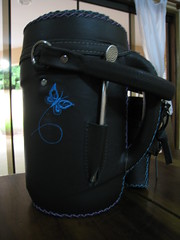
I figured I needed to post an update about my terere thermos. When I got back from Christmas break it was waiting for me with a friend and I have to say that it turned out to be remarkably close to what I had imagined while putting together my order. The dark brown leather with a purple and a teal butterfly embroided on it (my only complaint is that the two butterflies are so far apart you can’t see them both at the same time). The stitching is a mix of teal and purple. I can delight over the little details that always have to be a part of a thermos with all the extras – a sleeve for my bombillo (straw/strainer) and for the wampa (the cup). Perhaps my favorite though is the wampa itself. Smaller, the design show up well with the butterfly standing out, and yes – it is made out of cow horn. Now I feel like I own my own little part of Paraguayan tradition.

Wednesday, March 10, 2010

Hinchada


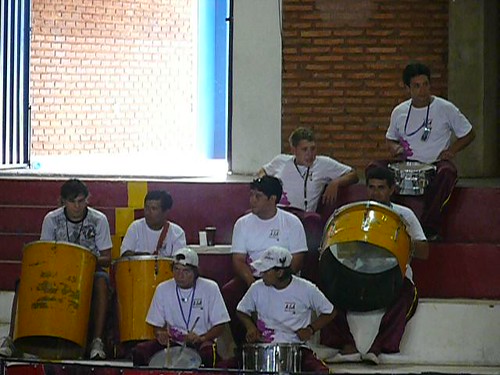
Bam, bam. Rat at at a. The banging on the drums signal the start of another game at Intercolegial. I find the fans to be more fascinating than the games themselves. Never before have I seen this kind of fan support for high school teams just playing in a city tournament. At some games a school manages to fill over half of the bleachers with jumping, screaming students. Have I mentioned they have drums? Chants pour forth out of the group and at times it is hard to think much less hear anything that is going on on the floor. And the referee whistle? Forget it. Even if you could hear it you would still have difficulty distinguishing it from the whistles coming out of the stands. The hinchadas will all be color coordinated (school colors of course), most likely with some sort of face paint. Where I started to get overwhelmed was when they unfurled a flag that took every person to hold up and flutter, a flag that takes more than 10 people to just carry into the stands. These people have it together! Coordinated enough to get the flag over all of the students and often to have matching shirts, this level of planning is impressive. I’m not so amused by the fireworks going off (some even in the gym the final day of play), but it still amazes me the level of commitment they have to cheering. It doesn’t surprise me that it is part of every professional football game here, but for high school sports? It is so hard to describe you probably aren’t getting an accurate picture, so please, just take a look at the videos.

Wednesday, February 24, 2010

First Impressions (or second)


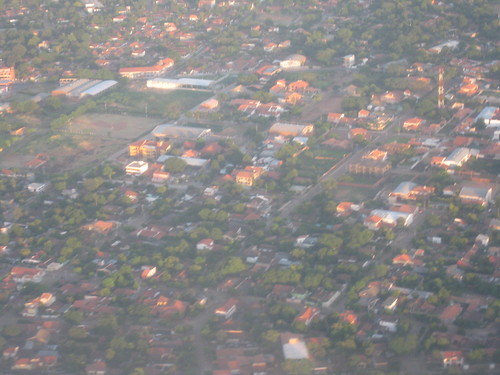
It seems funny to think about first impressions 6 months after first arriving but I felt as if that was exactly what I was getting when I flew into Asuncion in January. Perhaps a bit of time back at home and in Buenos Aires was enough to open my eyes. Flying in all I could think was green. There sure are a lot of trees in Asuncion. It really is quite a green city. My taxi driver was complaining about the traffic at 1:30 in the afternoon and while I have to admit there was some it still only took 30 minutes to get me home. I know its worse around 5:00 but you have to realize that nowhere in the city has more than two lanes in one direction. So the amount of traffic can’t begin to compare with the eight lanes of congestion you get in other cities. Asuncion really is a sleepy sort of capital city.

Houses are set close to the road; the idea of a front yard is not very practices. Houses jut up just past the sidewalk and the space is left for green in the more private backyards. I’m not sure if I would say there are individual lots, space is well used here and it seems that one building grows out of the walls of its neighbors – only wall color giving an indication as to where one ends and the next begins. What other differences will I notice as I continue to look around the city with my eyes actually opened now, instead of just focusing on my survival?